

Dr Kim Hailwood, NZPF Policy and Research Officer

The influence of E. D. Hirsch Jr. on education reform in Aotearoa New Zealand
E. D. Hirsch Jr., a prominent American education reformer, has played a pivotal role in shaping Aotearoa New Zealand’s current education reforms. The Minister of Education, Erica Stanford, has publicly acknowledged that Hirsch’s 1996 publication, The schools we need and why we don’t have them, was instrumental in developing her educational philosophy. The Minister’s embrace of these ideas has shaped the direction of New Zealand’s recent shift towards a knowledge-rich curriculum.
Hirsch contends that schools have systematically failed young people by neglecting to teach a common body of essential knowledge. In his influential 1987 book, Cultural literacy: What every American needs to know, Hirsch argues that literacy extends far beyond basic decoding skills. True literacy, he maintains, depends on students possessing specific cultural and factual knowledge that educated individuals commonly share and often assume others know.
To address the lack of this essential knowledge among students, Hirsch advocates for a highly structured, content-rich curriculum centred on concrete facts, significant historical events, key literary works, and foundational scientific concepts. Hirsch’s vision involves the development of comprehensive year-level curricula, which explicitly outline the content that all young people should master at each stage of their education, extending from new entrants through to Year 8.
According to Hirsch, establishing a common core of knowledge is essential for three interrelated reasons: it facilitates effective communication among individuals from diverse backgrounds, strengthens social cohesion, and promotes educational equity by ensuring all students, regardless of their background, receive the cultural capital necessary for academic and economic success.
Hirsch is particularly concerned with disadvantaged young people who may not acquire this knowledge at home. He asserts that it is the responsibility of schools to compensate for these knowledge gaps by offering a shared, structured curriculum. In his view, through this approach, schools can help level the educational playing field, providing genuine equality of opportunity and ensuring that no young person is left behind due to circumstances beyond their control.
International adoption of Hirsch’s core knowledge principles
Beyond the United States, Hirsch’s educational philosophy has gained its strongest foothold in England, where his Core Knowledge principles have significantly influenced national education policy since 2010. England adopted a knowledge-rich curriculum model that prioritises knowledge acquisition and factual content across all subjects. This approach was most notably championed by Nick Gibb, Minister of State for Schools, who explicitly referenced Hirsch’s work during England’s overhaul of its national curriculum, which was published in 2013.
Gibb argues forcefully against curricula grounded solely in student relevance, insisting that such a model deprives learners of exposure to “the best that has been thought and said”. He further contends that prioritising “so-called 21st Century skills” like creativity, teamwork, and problem-solving is “one of the most damaging myths in education today” (1). According to Gibb, these essential skills are not generalisable across disciplines and cannot simply be transferred from one subject to another. Instead, they require deep, subject-specific knowledge, a claim he maintains is supported by evidence about how people learn.
Contrasting international approaches: Moving beyond knowledge-heavy curricula
Although Hirsch’s ideas have gained traction in England and parts of North America, their influence has been limited elsewhere. Notably, prominent East Asian education systems are undertaking a deliberate shift away from rigid, knowledge-intensive frameworks. Countries such as Singapore, Japan, and South Korea are implementing curriculum revisions designed to foster creativity, critical thinking, and advanced problem-solving skills in order to move beyond a singular reliance on knowledge acquisition and memorisation.
Central to these structural changes is a commitment to interdisciplinary learning. By connecting academic subjects to practical, real-world challenges, these education systems strive to make learning more relevant and engaging. Rather than concentrating predominantly on rote memorisation, educators are now emphasising abilities such as analysis, synthesis, and evaluation. This shift aims to equip learners with the critical thinking skills necessary to navigate complex problems and situations, thereby elevating their educational experience beyond basic recall of information.
Similarly, Finland and other Nordic countries, which consistently rank among the world’s top education systems, adopt a markedly different philosophy. These nations foreground student wellbeing and integrate play-based learning, especially in the early years of education. Their frameworks grant considerable autonomy to teachers and favour flexible, locally-adapted curricula over standardised content requirements. Nordic systems prioritise nurturing a holistic and adaptable skill set in learners over rote learning of prescribed material.
The ongoing transformation of the global workforce has revealed a substantial gap between the skills developed in traditional education systems and those demanded by contemporary employers. Recent research shows that in today’s workplaces there is an increasing demand for dynamic abilities, including adaptability, effective collaboration, and problem-solving skills; capabilities that extend well beyond the mere retention of factual knowledge (2).
This gap poses particular challenges for education systems that have remained closely aligned with Hirsch’s knowledge-centric framework. Such models prioritise the mastery of predetermined content and rote memorisation, which, while providing a strong foundation of knowledge, may be less well-positioned to develop the flexibility, collaboration, and adaptability increasingly valued in contemporary workplaces. As a result, these education systems may face considerable obstacles in equipping learners with the full range of competencies necessary for success in today’s workforce.
England’s curriculum review findings
After more than a decade of implementing Hirsch’s knowledge-rich approach, the recently elected Labour Government in the United Kingdom commissioned an independent review of England’s curriculum, assessment, and qualifications system in July 2024. As the first comprehensive examination since the introduction of the 2013 national curriculum, the review provided crucial evidence about the long-term effects of adopting Hirsch’s educational philosophy at scale.
The resulting report, published in November 2025, underscored the necessity of updating the national curriculum to ensure it remains “cutting edge and fit for purpose to equip young people for our rapidly changing world” (3). While acknowledging that many elements of the existing system work well and recommending retention of the knowledge-rich curriculum’s structural foundations, the review identified several key challenges in how the curriculum has functioned in practice:
Persistent educational inequity. Despite the adoption of a standardised core knowledge approach designed to benefit disadvantaged students, the socio-economic attainment gap remains notably wide, and those with special educational needs continue to fall behind their peers. This outcome directly contradicts Hirsch’s central claim that a uniform curriculum would close equity gaps by providing all learners with essential cultural capital. In practice, the knowledge-rich model has failed to deliver the anticipated improvements in educational equity.
Imbalance between knowledge and skills. The review highlights the need to recalibrate the curriculum to better balance the teaching of core knowledge with essential skills such as digital literacy and critical thinking. An over-emphasis on content knowledge has undermined the development of analytical and creative abilities needed for modern life and work.
Limited flexibility and teacher autonomy. The curriculum’s standardised, one-size-fits-all model significantly restricts its ability to cater to diverse student interests and needs. This rigidity curtails teachers’ professional autonomy, limiting their capacity to tailor, adapt, or extend teaching materials. The standardisation impedes accommodation of individual learning needs and fails to ensure that all young people see themselves meaningfully represented within their educational experience.
Superficial coverage of knowledge. The extensive volume of mandated curricular content often results in learners attaining only surface-level familiarity with topics, rather than deep understanding. This paradoxical outcome compromises the stated goal of prioritising knowledge mastery. The fast-paced academic schedule leaves insufficient time for the thorough exploration of topics, hindering the development of real proficiency. These extensive curriculum demands have also reduced time for non-core subjects, such as the arts, music, and sport, narrowing the overall scope of educational experiences available to learners.
Insufficient preparation for modern challenges. The curriculum has not kept pace with rapid social, environmental, and technological changes. The review calls for greater attention to digital and media literacy, sustainability, climate science, and the skills required to navigate an AI-driven global world. It recommends that the national framework must better reflect contemporary society’s diversity and prepare students for challenges that were not foreseen when the core knowledge requirements were originally established.
Over-reliance on assessment. The focus on prescribed knowledge mastery has resulted in an excessive reliance on high-stakes examinations that fail to capture the full spectrum of student learning and capabilities. The review recommends reforms to reduce the assessment burden on both learners and educators.
Recommendations for a broader, more balanced curriculum
The review findings advocate for a more comprehensive and balanced curriculum. This includes enhanced access to the arts, music, sport, and vocational training, while maintaining strong foundations in literacy and numeracy. A key recommendation is a proposed ‘core enrichment entitlement’ to ensure all students benefit from experiences in civic engagement, arts and culture, nature and outdoor activities, sport, and the development of wider life skills. Rather than abandoning the emphasis on knowledge, the recommendations call for a careful rebalancing – an “evolution not revolution” – to address the identified deficiencies while preserving effective elements (4).
Critically, while acknowledging the significance of subject expertise, the review notes a concerning pattern: in some subjects, the current construction and balance of curriculum material actually impedes both depth of understanding and breadth of learning. This assessment suggests that strict application of Hirsch’s principles, with its commitment to encompassing a wide, mandated body of knowledge, may inadvertently obstruct the depth of understanding it aims to achieve.
Aotearoa New Zealand’s curriculum shift: Hirsch’s ideas in practice
The influence of Hirsch’s knowledge-rich philosophy is evident across New Zealand’s recently issued curriculum documentation. The 2024 mathematics curriculum (Phase 3, Years 7-8), for example, underwent substantial revision by October 2025, with changes that prioritise the acquisition and sequencing of core knowledge in alignment with Hirsch’s advocacy for coherent, cumulative learning.
However, the adoption of knowledge-rich approaches raises concerns similar to those emerging from England’s recent curriculum review, particularly regarding the balance between fostering deep understanding and ensuring systematic coverage of essential content.
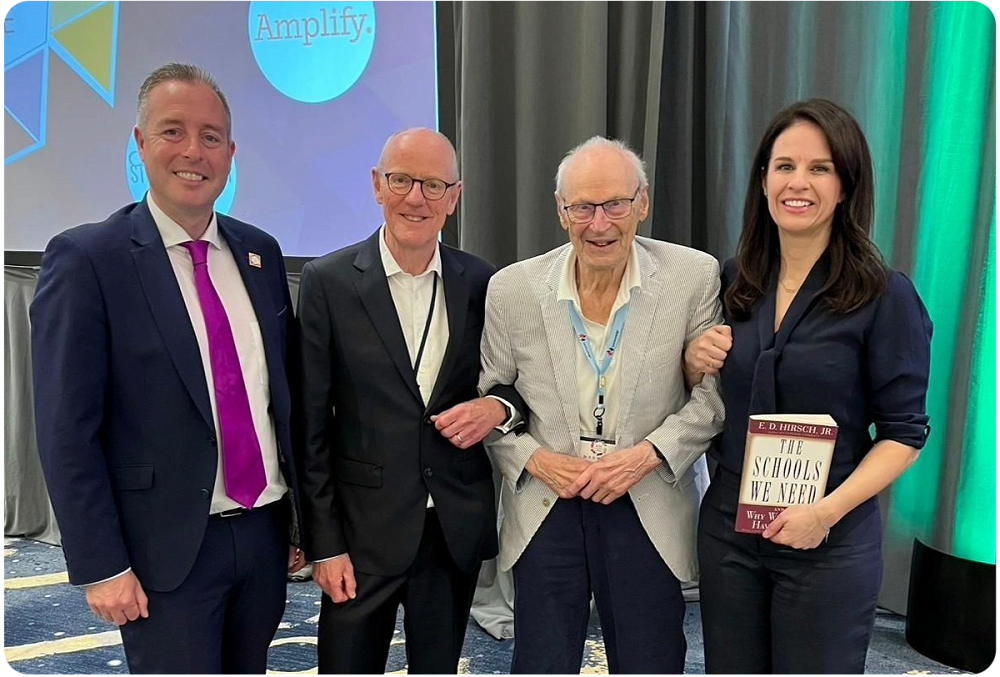
In June 2025, Minister Erica Stanford attended the Core Knowledge Foundation’s National Conference in Florida, meeting with Professor E. D. Hirsch Jr. (second from right), Northern Ireland’s Minister of Education Paul Givan (far left), and England’s former Minister of State for Schools, Sir Nick Gibb. Minister Stanford has identified both Gibb and Givan as role models for implementing reforms based on Hirsch’s work.
What this looks like in the classroom
To understand the practical implications of these curriculum reforms, it is useful to consider how the documented changes might manifest in everyday teaching practice. The following scenarios illustrate potential shifts in instructional approaches across three distinct mathematical strands. While not drawn from classroom observations, these examples are grounded in the documented curriculum changes and reflect the pedagogical implications of moving from a conceptual, inquiry-based framework emphasising reasoning and connections to one prioritising procedural knowledge and the development of mathematical practices.
|
Teaching fractions 2024 curriculum emphasis: Students explore why 3/4 and 6/8 are equivalent by investigating the relationship between numerators and denominators, using visual models and real-world contexts. They reason about what happens when you multiply or divide both parts of a fraction by the same number, developing conceptual understanding of equivalence. 2025 curriculum emphasis: Students learn the procedure for simplifying fractions by finding common factors. They practise applying the algorithm: identify the greatest common factor, divide both numerator and denominator, check the result. The emphasis is on accurate execution of the procedure. Potential impact: Students may be able to simplify fractions correctly but struggle to explain why the procedure works or when equivalent fractions are useful in real situations. |
|
Introducing algebra 2024 curriculum emphasis: Students begin by noticing patterns (for example, “If I have 3 bags with the same number of marbles in each, plus 2 extra marbles, and I have 17 marbles total, how many are in each bag?”). They develop their own ways to represent unknowns before being introduced to formal algebraic notation, understanding why algebra is useful. 2025 curriculum emphasis: Students are taught algebraic notation and equation-solving procedures from the start. They learn to translate word problems into equations (3x + 2 = 17) and solve for x using inverse operations. The focus is on correctly applying the solving procedure. Potential impact: Students may successfully solve textbook equations, but struggle when encountering unfamiliar problem types or fail to recognise when algebra might be useful in other situations. |
|
Statistics and data literacy 2024 curriculum emphasis: Students examine real datasets (for example, news articles claiming ‘crime is rising’) and learn to question: Who collected this data? How was it collected? What might be missing? Could the data be presented differently to tell another story? They develop critical data literacy alongside technical skills. 2025 curriculum emphasis: Students learn to create bar graphs, pie charts, and calculate measures of centre (mean, median, mode). They practise reading and constructing data visualisations following standard conventions. The ethical and societal dimensions receive substantially less emphasis. Potential impact: Students may produce technically correct graphs but lack the critical thinking skills to evaluate misleading statistics, biased sampling, or manipulated data presentations, all of which are skills increasingly essential in an era of misinformation. |
Curriculum framework shift: From ‘Understand-Know-Do’ to ‘Knowledge and Practices’
The examples described above reflect a documented trend throughout the mathematics curriculum. In 2024, the curriculum was structured on the ‘Understand-Know-Do’ framework. This method placed considerable weight on fostering students’ conceptual understanding, encouraging robust mathematical reasoning, and demonstrating the interconnectedness of mathematical concepts. The intention was to cultivate a deep comprehension of mathematics, allowing learners to see relationships between ideas and apply reasoning skills across different contexts.
The October 2025 revisions represent a deliberate departure from this earlier structure. The revised framework adopts a ‘Knowledge and Practices’ approach, which shifts attention toward the systematic mastery of content and the development of procedural fluency. Under this model, students are encouraged to build a strong foundation of core mathematical knowledge and to practise procedures until they achieve proficiency. This change underscores the curriculum’s renewed prioritisation of knowledge acquisition and proficient execution of mathematical processes, signalling a significant reorientation in teaching and learning priorities.
Implications for teaching practice
Reduced teacher autonomy and flexibility
The 2024 mathematics curriculum provided substantial pedagogical guidance, supporting teachers with explicit teaching strategies, opportunities for engaging learners in challenging tasks, and stressing the importance of fostering positive classroom relationships. It also addressed the need to manage cognitive overload, helping teachers to adapt their approaches to meet the diverse needs of their students.
In contrast, the 2025 curriculum iteration places greater emphasis on prescriptive content coverage, with a more itemised structure of learning objectives but minimal guidance on pedagogical approach; focusing on what to teach rather than how to teach it. Educators have expressed concern that this approach may reduce professional autonomy, with less flexibility to adapt or extend material for individual students. This concern reflects similar experiences in England, where the adoption of highly standardised curricula has been found to constrain teachers’ ability to tailor instruction to students’ unique interests, learning needs, or local contexts.
Breadth over depth
The 2025 curriculum features a more prescriptive structure, with itemised learning objectives and a substantially expanded range of content. While this clarity helps define expectations for both teachers and learners, critics have raised concerns about the increased volume of mandated material. The curriculum design prioritises coverage over exploration, which may result in learners gaining only a superficial grasp of mathematical concepts.
This concern mirrors the paradox identified in England’s curriculum review, where the pursuit of knowledge mastery can be undermined by the sheer volume of prescribed material. When the curriculum is tightly specified and extensive, opportunities for thorough investigation and consolidation of mathematical ideas may become scarce, potentially limiting depth of understanding.
Alignment with Hirsch’s model
The transition from the 2024 to 2025 curriculum versions demonstrates a deliberate move toward a highly structured approach, closely mirroring Hirsch’s educational philosophy, particularly through:
-
Prescribed, sequential content. The curriculum specifies detailed, year-by-year content that ensures standardised progression for all students.
-
Knowledge-centred approach. Factual knowledge becomes the primary focus, with reasoning skills and conceptual connections taking a secondary role in curriculum organisation.
-
Reduced teacher flexibility. Standardised coverage is mandated across all learning environments, limiting teachers’ ability to adapt curriculum materials to individual student needs or local contexts.
-
Linear, strand-based organisation. Content is organised into discrete, sequential strands that promote a linear rather than integrated or interdisciplinary framework.
-
Assessment-aligned objectives. Learning objectives are designed for standardised assessments, emphasising checklist-style competencies that measure attainment of specific knowledge points over broader developmental progress.
Reflecting on international lessons
Aotearoa New Zealand is now implementing the curriculum framework that England adopted over a decade ago and has since critically reviewed. The review found that, in some subjects, the existing structure and balance of content have actually hindered students’ ability to gain substantive command of the material. This approach has contributed to a reduction in both the depth of understanding and breadth of learning opportunities available to young people.
By following a model that has demonstrated these limitations in England, Aotearoa New Zealand risks repeating the same mistakes instead of learning from international experience.
Citations
(1) Gibb, N. (2021, July 21). The importance of a knowledge-rich curriculum [Speech]. Social Market Foundation. https://www.gov.uk/government/speeches/the-importance-of-a-knowledge-rich-curriculum
(2) World Economic Forum. (2025). The future of jobs report 2025. https://www.weforum.org/publications/the-future-of-jobs-report-2025/
(3) Francis, B. (2025). Building a world-class curriculum for all. Curriculum and Assessment Review final report. Department for Education. (p. 7).
(4) Francis, B. (2025). Building a world-class curriculum for all. Curriculum and Assessment Review final report. Department for Education. (p. 13).
